
Quick Answer
To optimize a basement’s Feng Shui, transform its naturally stagnant, subterranean yin energy into vibrant yang vitality. Because underground spaces are encased by earth, they easily trap damp, heavy energy. You can counteract this by layering dynamic lighting to mimic natural sunlight, choosing warm earth tones and crisp wood element colors, using specific air-purifying plants like Mother-in-Law’s Tongue to move stagnant chi, and anchoring the space with low-profile, grounded furniture. Avoid placing large mirrors facing stairs or dark corners, which can amplify chaotic energy.
My Journey Underground: A Real-World Feng Shui Reality Check
A few years ago, I took on a project that nearly broke my spirit as a designer. A client, Sarah, hired me to convert her subterranean space into a hybrid home office and guest suite. On paper, the layout was great. In reality, stepping down those stairs felt like walking into a damp sponge. The air was heavy, the light was non-existent, and within twenty minutes of working down there, I would inevitably develop a dull headache.
Initially, I tried to fix it using a standard checklist. I threw in standard overhead lighting, slapped some bright white paint on the walls, and added a massive decorative mirror to bounce light around.
It was a total disaster. The bright white paint turned a depressing, sickly gray under the artificial lights. The mirror didn’t make the room feel larger; instead, it reflected a dark, messy storage corner, making the space feel doubly chaotic. Sarah found herself avoiding the room entirely, complaining that she felt anxious the moment she sat at her desk.
That failure forced me to throw out generic advice and study how underground room feng shui actually behaves. A basement isn’t just a regular room with fewer windows. It is literally encased in dirt, surrounded by heavy, crushing earth energy. It is the ultimate yin environment—cold, dark, quiet, and still. To make it livable, you cannot just decorate it; you have to actively shift the physics of its subtle energy, transforming stagnant dampness into a vibrant, supportive basement chi flow.
Here is the blueprint I developed through years of trial, error, and ultimate success.
1. Navigating the Underground Yin-Yang Imbalance
In classical Feng Shui, the balance between yin (passive, dark, cold energy) and yang (active, bright, warm energy) is everything. Above-ground rooms naturally experience a healthy daily shift between the two thanks to rising and setting suns, wind, and open windows.
A basement, however, suffers from a permanent excess of yin.
[Excessive Yin Energy] --> Leads to: Lethargy, dampness, mental fog, stalled projects
       ↓
[Strategic Yang Adjustments] --> Achieved by: Fire/Wood element cures, air movement, dynamic lighting
       ↓
[Harmonious Chi Flow] --> Results in: Focus, vitality, and a welcoming atmosphere
When yin is too dominant, the energy pooling in your floorboards stagnates. This manifests in the human body as a feeling of lethargy, unproductivity, and mental fog. My first step with any lower-level project is always a thorough basement energy clearing. Before you buy a single piece of furniture, you must clear out physical and energetic stagnation:
- Purge the dead weight: Basements routinely become dumping grounds for broken appliances, old clothes, and forgotten paperwork. In Feng Shui, clutter represents postponed decisions. Holding onto it underground acts like an anchor on your personal progress.
- Move the stale air: Pop a dehumidifier down there immediately. Dampness is a physical manifestation of stagnant water element energy.
- The sound and smoke cure: Open whatever small windows you have, use a high-quality singing bowl or bell in the corners to break up stuck energy fields, and burn a clarifying botanical like cedar or rosemary.
2. Lighting: Creating a Faux Sun
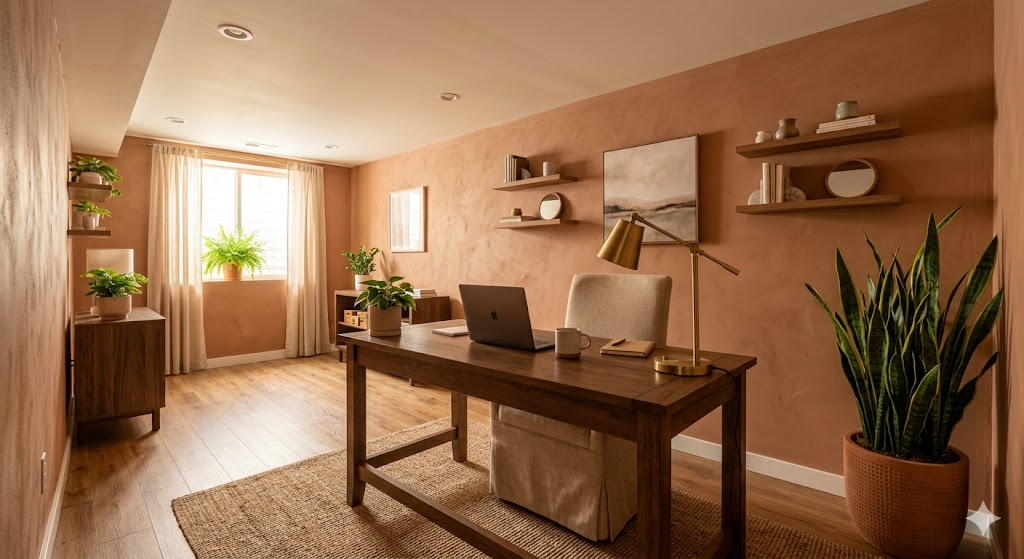
Lighting is your primary weapon against excessive yin. If your basement lacks natural windows, you have to create the energetic illusion of the sun. The biggest mistake I see—and the one I made at Sarah’s house—is relying solely on a grid of recessed ceiling spotlights. This casts harsh down-shadows, highlighting the fact that you are underground and making the ceiling feel incredibly low.
To create the best feng shui lighting for basement environments, you must layer your light sources across three distinct levels to lift the energy upward.
The Three-Layer Lighting Blueprint
- The Ambient Layer (The Sky): Use indirect LED coves or flush-mount fixtures that throw light up against the ceiling. This visually raises the roof and mimics the expansive feeling of the open sky.
- The Task Layer (The Sun): Place bright, clean desk lamps and reading lights where you work or relax. Opt for full-spectrum bulbs (between 3000K and 4000K) that replicate true daylight. Avoid cold, blue-toned fluorescent bulbs, which drain human energy fields.
- The Accent Layer (The Horizon): Place floor lamps in dark corners to push the boundaries of the room outward. Up-lighting behind a large plant creates beautiful, moving shadows that introduce active yang movement into dead spaces.
3. The Color Strategy: Balancing Five Elements
Because a basement is literally carved out of the earth, it naturally overflows with basement earth element feng shui. While earth energy provides stability, too much of it feels suffocating, heavy, and unyielding—like being buried. To find harmony, we must look at how the five elements interact.
[Fire Element]
(Warms the cold)
↓
[Wood Element] ──> [Earth Element] ──> [Metal Element]
(Breaks up soil) (Naturally heavy) (Cuts through fog)
↑
[Water Element]
(Keep minimal/controlled)
To lighten the heavy earth load, you want to bring in the elements that naturally balance it: Wood (which breaks up thick soil), Metal (which clarifies and focuses), and Fire (which warms the cold darkness).
When choosing the best feng shui colors for basement walls and major decor, stay away from stark, blinding whites or muddy, cool grays. Instead, curate a palette that feels intentionally warm and alive:
- Warm Terracottas and Soft Ochres: These maintain a healthy connection to the earth element without feeling heavy or oppressive.
- Crisp Sages and Soft Olives: These introduce basement wood element feng shui, bringing the vibrant, upward-growing energy of nature indoors to break up the static air.
- Warm Cream and Alabaster: If you want a neutral backdrop, choose creams with distinct yellow or red undertones to keep the room cozy.
Avoid overusing dark blues, blacks, or deep purples. These shades feed into the basement water element feng shui, which is already naturally drawn downward by gravity. Too much water element in an underground space leads to emotional instability, deep sadness, and a lack of motivation.
4. Furniture and Rugs: Grounding Without Sinking
Arranging furniture underground requires an understanding of spatial pressure. Ceilings are typically lower, and structural poles or bulkheads can disrupt the smooth movement of energy.
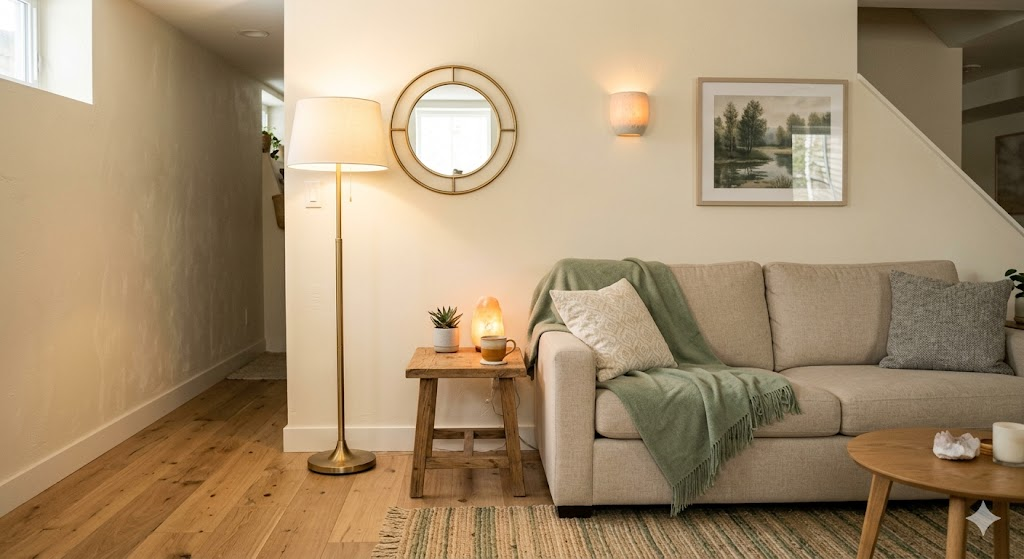
When sourcing the best feng shui furniture for basement spaces, focus on a low profile with clean, rounded edges. Heavy, oversized, dark mahogany Victorian furniture will make the space feel like a subterranean dungeon. Instead, opt for lightweight, elevated frames where the legs lift the body of the couch or chair off the ground, allowing chi to flow underneath.
Always position your primary seating or desk in the commanding position. This means you can easily see the entrance to the room without being directly in line with it. Never place your back to the entryway of a basement; because the environment is already high-yin, having your back turned triggers a subtle, primal survival response that spikes anxiety.
+—————————————+
| [Dark Corner] [Desk / Seat] |
| (Fix with Lamp) (Commanding) |
| |
| |
| |
| [Doorway] |
+—————————————+
Softening the Floor with Rugs
Because basement floors are usually cold concrete or synthetic vinyl, they pull warm energy away from your feet. To counteract this, look for the best feng shui rugs for basement layouts. Choose thick, plush natural fibers like wool or woven cotton.
From a shape perspective, prefer round or oval rugs. Sharp, rectangular rugs can cut up a room’s layout, whereas circular patterns encourage a gentle, swirling basement chi flow that keeps the room’s energy lively and continuous.
5. Strategic Mirrors and Art: Crafting New Horizons
In standard rooms, mirrors are simple design elements. In lower-level rooms, they act as energetic portals. The best feng shui mirrors for basement use are those hung intentionally to expand your sightlines.
Mirror Mistakes and Fixes
Never place a mirror directly opposite the basement stairs. When energy flows down the staircase, a mirror placed right at the bottom will bounce that incoming chi straight back up, preventing the basement from ever getting properly energized.
Instead, hang a large, high-quality mirror on a wall perpendicular to a window or an open doorway to pull light into deep recesses. Ensure the mirror reflects something beautiful—like a vibrant piece of art or a healthy plant—rather than storage boxes or exposed utility pipes.
Selecting Uplifting Art
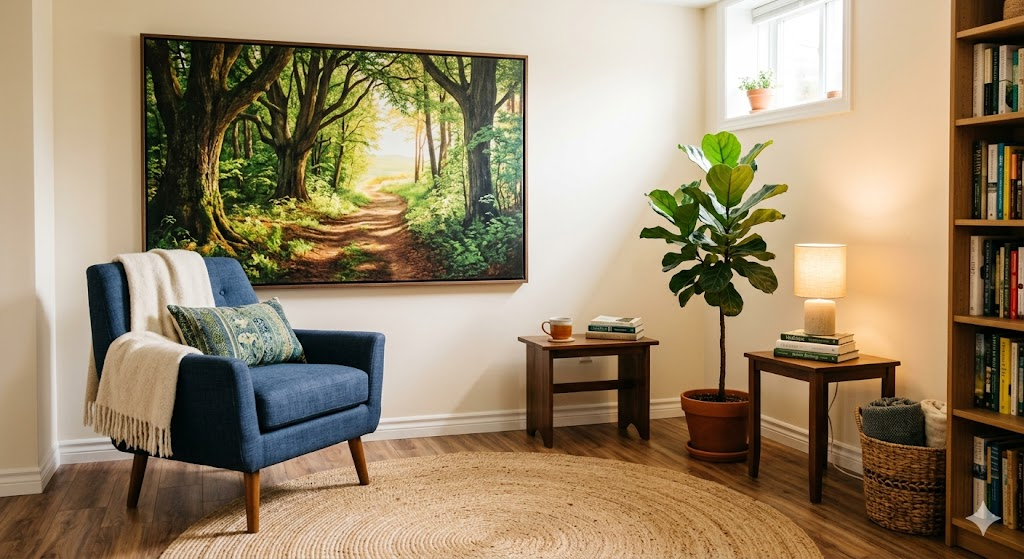
The best feng shui art for basement rooms should feature elements of depth, open horizons, and upward movement. Avoid abstract, chaotic graphics or depressing, lonely landscapes.
Look for images of sun-drenched pathways, forests growing toward the sky, or mountain ranges with bright suns. This visual storytelling tricks the subconscious into believing there is an expansive, safe world right outside the wall, instantly relieving any feelings of claustrophobia.
6. Living Energy: Plants and Crystals
Introducing true living energy into a basement is a major challenge, but it is absolutely essential for breaking up a heavy environment. Plants bring in the basement wood element feng shui, which inherently pushes upward against the downward crush of the subterranean world.
To find the best feng shui plants for basement settings, you must choose varieties that can thrive in low-light environments. My absolute favorites are:
- Snake Plants (Mother-in-Law’s Tongue): These are nearly indestructible and have a strong, sword-like upward growth pattern that acts like an energetic antenna, lifting heavy chi.
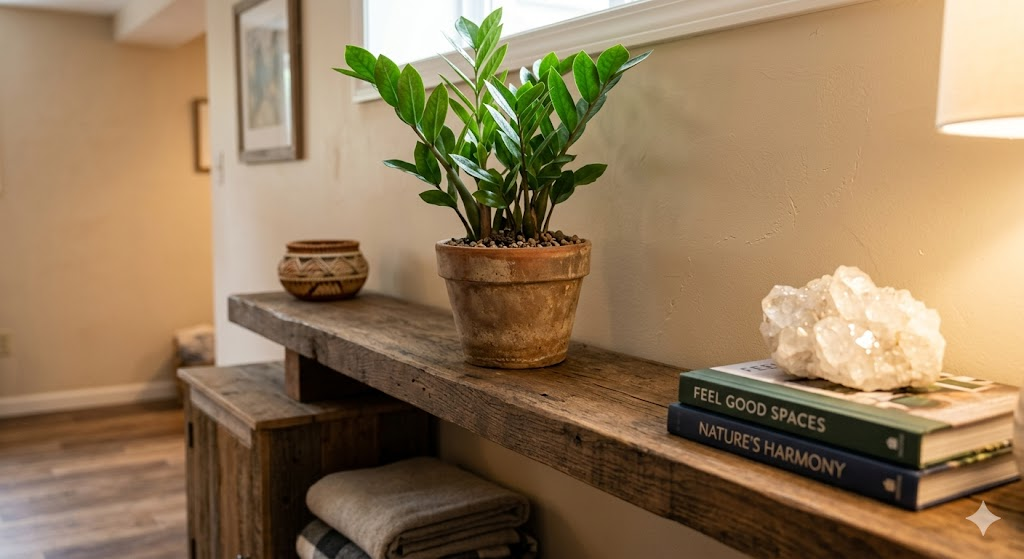
- ZZ Plants (Zamioculcas zamiifolia): Their glossy, emerald-green leaves reflect light beautifully and symbolize enduring wealth and steady growth.
- Pothos (Devil’s Ivy): While its vines naturally cascade downward, you can train a Pothos to climb up a small trellis or wall hook, directing the room’s energy skyward.
If your basement is completely devoid of natural light, do not let real plants slowly rot down there; dead energy is terrible Feng Shui. Instead, invest in high-quality silk replicas or install specific grow-lights disguised as standard task lamps to keep live plants thriving.
The Crystal Toolkit
Crystals are highly organized structures that radiate clean vibrational frequencies. When choosing the best feng shui crystals for basement spaces, look to the basement metal element feng shui to cut through stagnant energy blocks.
| Crystal | Element Focus | Primary Purpose | Ideal Placement |
|---|---|---|---|
| Clear Quartz | Metal / Clarity | Amplifies light and breaks up dense, heavy energetic fog. | Near light sources or on desks |
| Black Tourmaline | Earth / Protection | Absorbs electromagnetic stress from basement appliances and utility meters. | Near entryways or electrical panels |
| Citrine | Fire / Abundance | Introduces artificial sunshine and warm yang energy to invite wealth. | Center of the room or wealth corner |
Troubleshooting Common Basement Architecture Dilemmas
Real-world basements rarely look like perfect design catalogs. They are full of structural challenges that require clever, conscious workarounds.
Low Ceilings and Bulkheads
Exposed support beams or dropped ceilings hiding air ducts can create oppressive energy lines called “poison arrows.” If a structural beam runs directly over your bed or office chair, it symbolically applies constant pressure to your mind or body, leading to chronic stress.
- The Fix: Paint the beams or bulkheads the exact same color as the ceiling to make them visually disappear. Alternatively, hang a pair of small bamboo flutes with the mouthpieces pointing up to symbolically deflect that downward pressure away from your body.
Missing Windows
A room completely cut off from the outside world can quickly turn into an energetic dead zone.
- The Fix: Create a “virtual window.” Hang a large, framed, window-pane style mirror over a landscape canvas, or build a faux window frame backed by an adjustable LED light panel to mimic a real exterior window.
Mechanical Rooms and Electrical Panels
The roar of furnaces, water heaters, and washing machines creates highly chaotic, unstable chi.
- The Fix: Keep these spaces physically hidden behind solid doors or heavy fabric curtains. Hang a small crystal ball or place a piece of black tourmaline right outside the utility closet door to contain and ground that disruptive electromagnetic energy.
The Ultimate Checklist for Lower-Level Harmony
To make sure your basement layout flows smoothly, use this simple checklist before finalizing your setup:
- Physical Purge: Are all old, broken, and unneeded items cleared out of the corners?
- Humidity Control: Is a dehumidifier running consistently to keep the air dry and light?
- Commanding Position: Can you see the main entrance clearly from your bed, sofa, or desk?
- Ceiling Relief: Are low beams and bulkheads painted to match the ceiling to lessen downward pressure?
- Layered Lighting: Do you have at least three separate light sources to elevate dark spaces?
- Living Chi: Are low-light plants or grow lights placed intentionally to keep natural energy moving?
Frequently Asked Questions
Can a basement bedroom ever have truly good Feng Shui?
Yes, but it requires diligent maintenance. Because bedrooms naturally need a peaceful yin energy to support restorative sleep, a basement’s quiet nature can actually be beneficial. However, you must prevent that quiet energy from turning into cold stagnation. Use warm wall colors, solid wooden headboards anchored against strong walls, and clear out everything under the bed so chi can flow around you while you sleep.
Where should I place a bathroom in a basement layout?
In Feng Shui, bathrooms are major energy drains due to the constant presence of flushing water. If you are building a basement bathroom, try to avoid placing it in the direct center of the home’s overall floor plan. Keep the bathroom door closed at all times, keep the toilet lid down, and introduce earthy colors like terra cotta or sandy tones to metaphorically soak up that excess water energy.
What should I do if my basement has zero natural windows?
Focus heavily on artificial daylight. Combine uplighting to raise the ceiling with full-spectrum task lamps that mimic the sun. Use expansive art landscapes that feature deep horizons, and place strategic mirrors to reflect your main interior light sources, instantly making the space feel open and connected.