
By Maya Chen·Updated May 2026·11 min read·2,050 words
Quick Answer
The best feng shui tips for a studio apartment layout focus on defining clear zones for sleeping, working, and living; positioning your bed in the command position away from the door; controlling clutter aggressively; and using mirrors, plants, and dividers to guide chi flow without shrinking the space.
Table of Contents
I moved into a 380-square-foot studio three years ago, optimistic and naive. Within two months I was sleeping badly, working distracted at a desk wedged between the fridge and the bathroom door, and wondering why I felt vaguely anxious every time I came home. Nothing in the apartment was wrong, exactly. But nothing felt right either.
A feng shui consultant friend walked through with me one afternoon. She didn’t say much — just stood in the entrance, looked around slowly, and said: “Your chi has nowhere to go. It comes in, hits the bed, and dies.” That phrase stuck. And once I started rearranging based on her advice, the difference was noticeable within a week — not mystical, but measurable in how I slept, how I worked, how I felt walking through the door.
What follows is what I’ve learned from that experience, from applying these principles in other small spaces since, and from reading more deeply into classical feng shui theory. Studio apartments present a unique challenge: you’re compressing kitchen, bedroom, living room, and often an office into one room. The principles below address that directly.
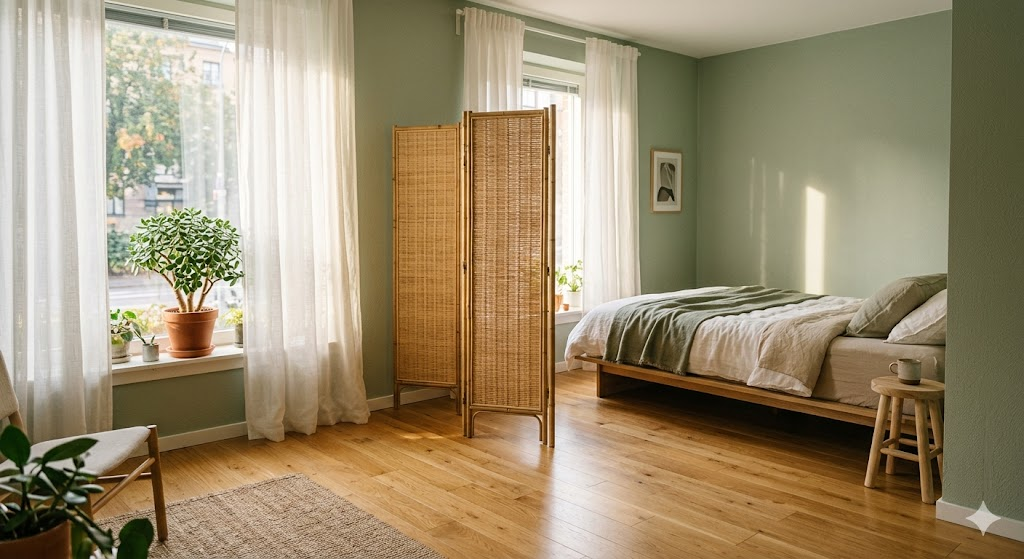
A minimalist studio apartment with warm afternoon light streaming through sheer curtains, a low-profile platform bed in the far corner positioned diagonally to face the entrance, a bamboo room divider separating the sleeping zone, potted jade plant on a windowsill, and a clear, uncluttered wooden floor. Soft sage-green walls. Warm, editorial photography style, slight film grain, natural tones.
A well-zoned studio: each life area has its own defined space, even within a single room.
Why does feng shui feel different in a studio apartment?
In a traditional home, rooms handle the zoning for you. The bedroom is for rest. The office is for work. The kitchen is just the kitchen. In a studio, all of that collapses into one open floor plan, which creates what feng shui practitioners call “energy confusion” — your nervous system can’t fully enter sleep mode in a bed that’s three feet from your work desk.
The core feng shui challenge in a studio isn’t decoration. It’s definition. You need to create the feeling of distinct spaces — psychologically and energetically — without walls. Once that foundation is in place, every other tip in this article lands with far more impact.
What is the best feng shui layout for a studio apartment?
The most functional feng shui layout for a small studio follows what I call the Zones Before Objects approach: identify three primary zones first, then place furniture. Those zones are the rest zone (bed), the work zone (desk), and the living/social zone (sofa/seating). The kitchen is usually fixed, so it functions as an anchor.
01
Rest Zone
Bed in the command position — farthest from the door, facing it diagonally, never in line with the door.
02
Work Zone
Desk away from the bed — ideally separated by a divider or at least 6 feet of clear space.
03
Living Zone
Sofa or chairs facing the entrance, creating a welcoming social anchor near the front of the space.
04
Entry Zone
A clear, uncluttered entry — even 3 feet of open space — for chi to enter and settle before moving inward.
In practice this means your bed should be the last thing you reach when you walk in. Most studio renters instinctively push the bed against the far wall anyway — feng shui just formalizes why that works.
The biggest layout mistake I see in studios
Putting the desk at the foot of the bed. I did this for my first two months. The result: every time I lay down, I stared directly at my laptop. Work energy bled into sleep space constantly. Moving the desk to a perpendicular wall — even the same corner — made an immediate difference. If there is genuinely no alternative placement, use a folding screen behind the desk when it’s not in use.
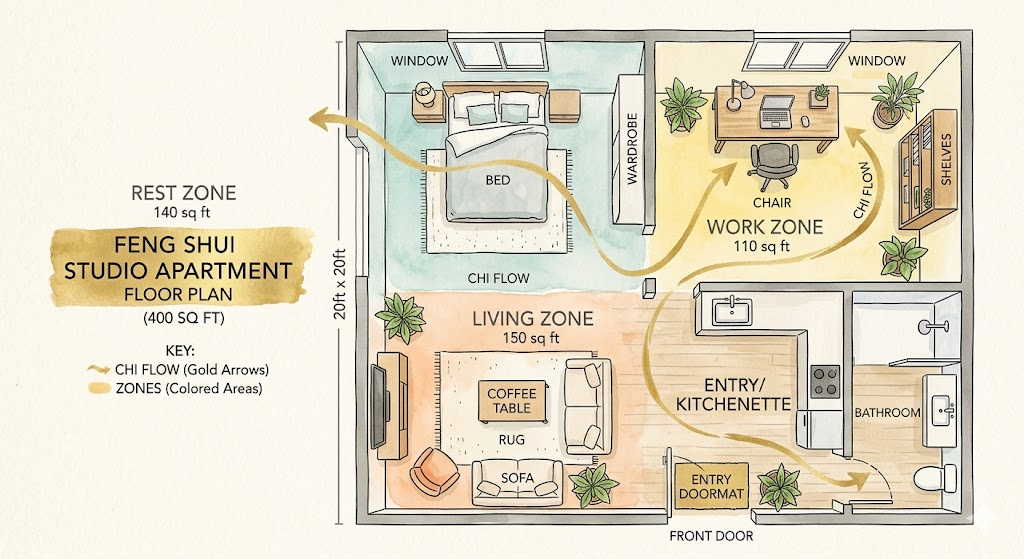
An overhead floor plan illustration of a 400 sq ft studio apartment showing three clearly labeled feng shui zones — Rest (back-left), Work (back-right), Living (front-center) — rendered in soft watercolor with chi flow arrows in gold, minimalist editorial infographic style on cream paper background.
The three-zone feng shui layout for a studio — the foundation before any furniture placement.
How should you position the bed in a studio apartment for good feng shui?
Bed placement is the most critical feng shui decision you’ll make in any bedroom — and in a studio, it’s especially loaded because the bed dominates the entire space visually and energetically.
The principle is the command position: your bed should be placed so you can see the door while lying down, but not be directly in line with the doorway. This means diagonal placement from the entrance is ideal. The headboard should rest against a solid wall, never float in the middle of the room or sit under a window.
In studios, the most common conflict is that placing the bed in the command position sometimes puts it closer to the kitchen. If that’s unavoidable, a tall plant, a bookshelf, or a fabric room divider between the bed and kitchen area acts as an energetic buffer. The cooking zone carries fire energy (stove) and water energy (sink) that can be agitating if they’re the last thing your subconscious registers before sleep.
Practitioner Tip
Never place your bed so your feet point directly at the door. This is called the “coffin position” in classical feng shui — and regardless of symbolism, most people who try it report feeling anxious or unable to fully relax. If it’s your only option due to room layout, hang a small wind chime or place a low bench at the foot of the bed to interrupt the direct line.
What are the best feng shui colors for a studio apartment?
Color in feng shui isn’t arbitrary — each hue connects to one of the five elements (wood, fire, earth, metal, water) and influences the energy of a space accordingly. For studios, where you need one palette to serve multiple functions, the goal is balance, not drama.
My personal recommendation for studio walls: earth tones. Warm whites, soft greiges, terracotta, pale sage green. These support stability and grounding — exactly what a space that asks you to sleep, work, and socialize all in the same room needs. I’ve painted three studios over the years. The warm white and the dusty sage both worked well. The bold teal I tried in one apartment looked beautiful in photos and made me feel subtly restless for the entire lease — too much water energy with nowhere to balance it.
| Color / Element | Energy It Brings | Best Used For | Studio Use |
|---|---|---|---|
| Warm White / Cream (Metal) | Clarity, calm | Walls, large surfaces | ✓ Ideal main wall color |
| Sage Green / Moss (Wood) | Growth, vitality | Accent wall, textiles | ✓ Calming, works for both rest + work zones |
| Terracotta / Warm Tan (Earth) | Stability, nourishment | Pillows, rugs, artwork | ✓ Excellent grounding accent |
| Deep Navy / Teal (Water) | Flow, creativity | Single accent piece | ↑ Use sparingly — overstimulating in large doses |
| Bright Red / Orange (Fire) | Energy, passion | Single decorative object | ↑ Avoid in sleep zone, fine in living area |
How do room dividers improve feng shui energy in a studio?
Room dividers are one of the most underused tools in studio feng shui. Done well, they define zones without closing off the space. Done poorly (think: a solid bookcase shoved sideways), they block light and create dead corners where energy stagnates.
The best feng shui room dividers for studios are semi-transparent or breathable: bamboo screens, open-frame bookshelves, hanging fabric panels, tall plants in a row, or hanging macramé. These create visual separation without fully blocking airflow or light.
When I finally added a 5-foot bamboo folding screen between my desk and my bed, the psychological effect was immediate. Sitting at my desk felt like “being at work.” Lying in bed no longer meant staring at the laptop glowing across the room. The screen didn’t change the room’s square footage — it changed the room’s identity.
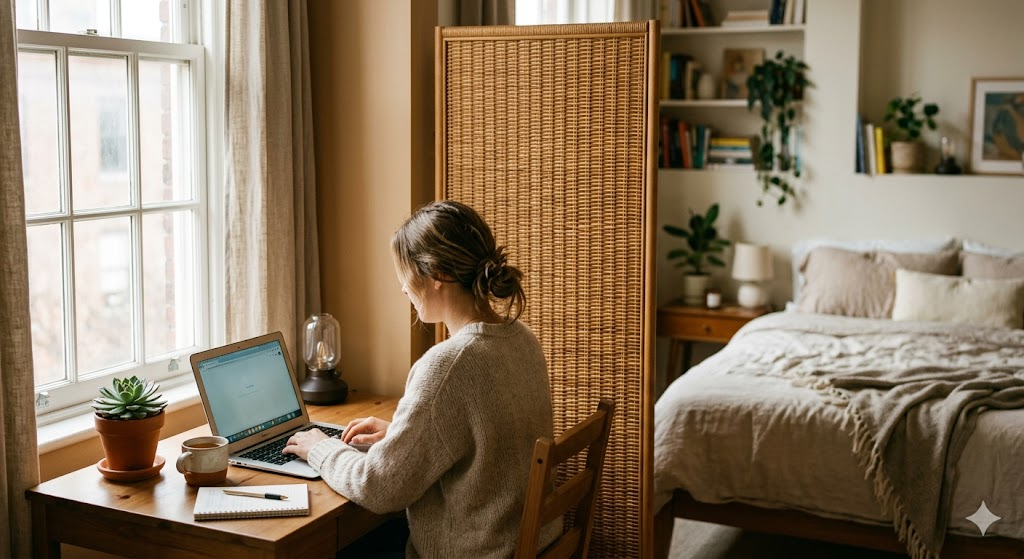
A studio apartment workspace separated from the bedroom by a tall woven rattan screen. Natural morning light from a side window falls across a wooden desk with a laptop and a small potted succulent. The sleeping area is soft and blurred behind the screen. Warm, calm atmosphere. Soft-focus editorial photography with shallow depth of field.
A semi-transparent room divider lets light pass while defining your work and rest zones energetically.
Where should you place a mirror in a studio apartment for feng shui?
Mirrors in feng shui serve a double function: they expand visual space and redirect or amplify chi. In a studio, both applications are useful — but mirrors can also amplify problems if they’re placed carelessly.
Good mirror placements: On a wall perpendicular to the entrance (expands the sense of depth), in the living zone to reflect natural light, or on the back of a closet door to “disappear” the door.
Avoid: Mirrors directly facing the bed (disrupts sleep energy), mirrors facing the front door (pushes chi back out), and mirrors positioned to reflect cluttered areas (amplifies the chaos).
One specific trick that transformed my own studio: I placed a narrow vertical mirror — about 18 inches wide, 5 feet tall — on the wall beside my window rather than opposite it. It bounced afternoon light deeper into the apartment without creating a glare problem or pointing at anything I didn’t want amplified. The room felt 25% bigger overnight.
Expert Insight — From Feng Shui Practitioner Discussions
A common observation in the feng shui community: most people over-mirror their studios. One large, well-placed mirror does more work than three smaller mirrors scattered randomly. The reasoning holds practically — each mirror reflects something. Before hanging it, stand at the intended position and look at what it shows. If it’s reflecting a pile of boxes or the inside of your bathroom door, move it. Mirrors should reflect beauty — ideally something natural like a plant, a window, or an open, clean wall.
Which plants work best for studio apartment feng shui?
Plants are among the most accessible and effective feng shui tools available. They bring wood element energy, which supports growth and vitality. In studios, the right plant placement also softens sharp corners (called “poison arrows” in classical feng shui) and adds movement and life to areas that feel static.
The best feng shui plants for a studio apartment are those that thrive in the light conditions you actually have — not the ones that look best in photos. A struggling, yellowing plant is a feng shui problem, not a solution.
For low-to-medium light studios: Pothos, ZZ plant, peace lily, snake plant. All bring good feng shui associations (purifying, protective) and forgive irregular watering.
For bright studios: Jade plant (prosperity, wood energy), money tree (abundance), fiddle-leaf fig (strong wood element presence), citrus plants (if you have a south-facing window).
Placement: Corners and entry areas benefit most. Placing a medium-sized plant in the far-left corner from the entrance activates the “wealth corner” per the bagua map. Near your desk, a small succulent or pothos pulls stagnant work energy and keeps the space feeling alive.
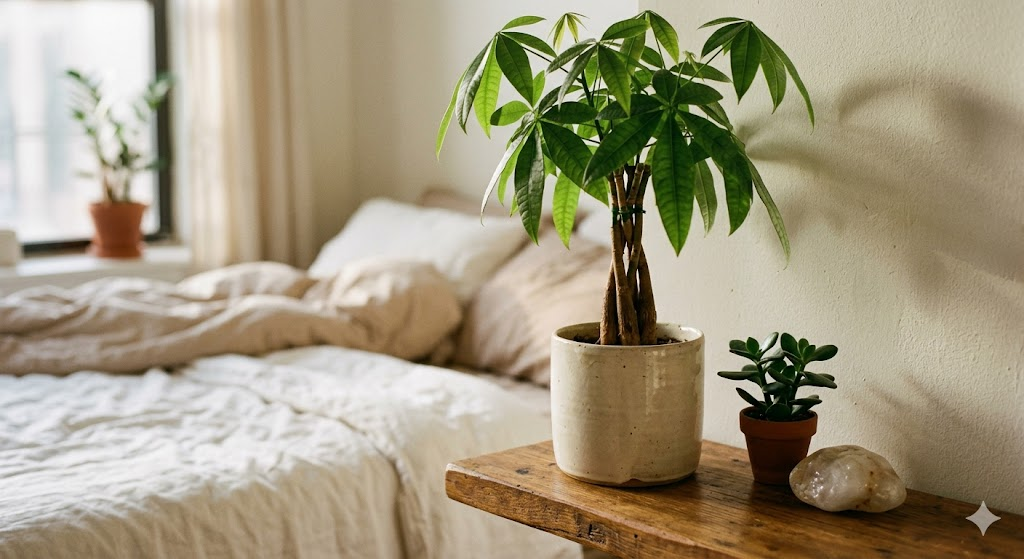
Close-up of a money tree plant in a cream ceramic pot sitting on a wooden corner shelf in a studio apartment. Golden afternoon light. Beside it, a small jade plant and a smooth quartz stone. Background shows a blurred bed with white linen. Warm, minimal, organic aesthetic. Film grain, soft shadows.
The wealth corner in the far-left of your studio is activated most effectively with healthy, vibrant plants.
How does clutter affect chi flow in a small studio?
In a large home, clutter in one room doesn’t necessarily affect the whole space. In a studio, it contaminates every zone because there are no walls to contain it. Clutter in feng shui represents stuck energy — things you’re holding onto that no longer serve you, obstacles that slow the movement of chi through your home and, by extension, through your life.
The practical fix isn’t minimalism for its own sake. It’s strategic containment. Everything in your studio should have a designated home, and surfaces — especially the floor — should be clear by default. Under-bed storage and vertical shelving are your best friends. The rule I follow: if something doesn’t have a place to live, it doesn’t live in the apartment.
“Clutter is not just an organizational problem. It’s an energetic announcement that you can’t make decisions — and your space will feel that way to everyone who walks in, including you.”
Pay special attention to the entrance. Even if the rest of your studio is chaotic, a clear, clean entry makes an enormous difference. That’s the first thing chi encounters when it comes in. A pile of shoes and bags at the door is the energetic equivalent of a blocked artery.
What lighting creates the best feng shui in a studio apartment?
Lighting in feng shui is linked to fire energy — it brightens the space, lifts mood, and encourages active chi. In studios, most renters are stuck with a single overhead fixture that’s functional but flat and unflattering. Layering your lighting is the most underrated feng shui upgrade available.
The goal is at least three light sources operating at different heights and serving different purposes: ambient (overhead or floor lamp), task (desk lamp, reading light), and accent (candles, LED strip under shelving, table lamp in the corner). This creates natural zones even in a studio and allows you to shift the energy of the space from work-mode to rest-mode simply by changing which lights are on.
Expert Insight — Design + Feng Shui Community Observation
A recurring observation among feng shui practitioners who work with small apartments: warm bulb temperature (2700–3000K) is non-negotiable in sleep zones, but most people use the same cool-white or daylight (5000K+) bulbs throughout their studios. The result is a space that feels alert and clinical even at 10pm. Switching to warm-tone bulbs in bedroom-area lamps — even just two lamps — dramatically changes the quality of evening energy and makes the transition to sleep much more natural. The fix costs under $15 and is one of the highest-ROI feng shui changes possible in a studio.
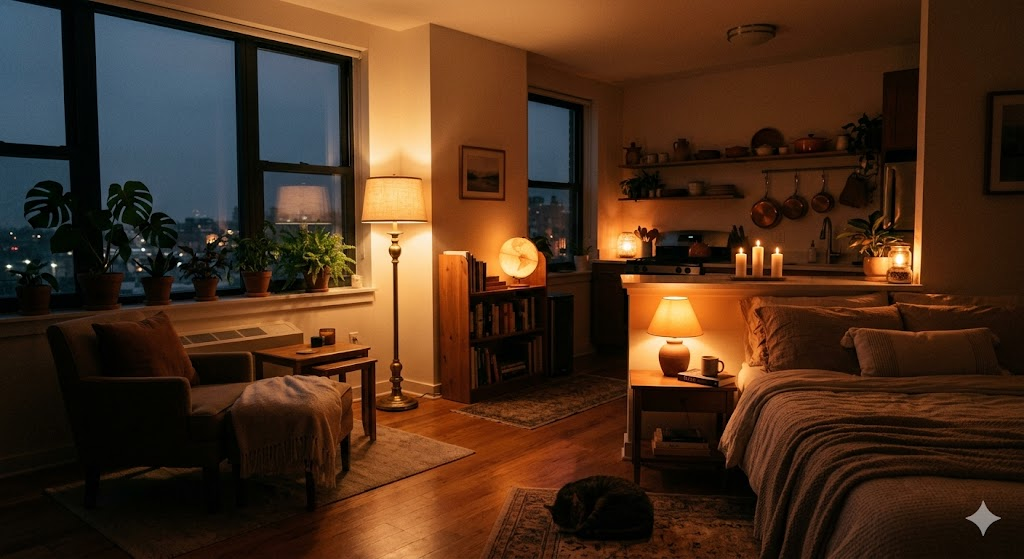
A cozy studio apartment at dusk lit entirely by warm-toned lamps — a floor lamp in the corner, a small table lamp beside the bed, candles on the kitchen counter. The overhead light is off. The space glows amber and terracotta. Soft shadows. Potted plant on a shelf silhouetted against the window. Cinematic, intimate, peaceful mood.
Warm-toned layered lighting is the fastest way to transform the energy of a studio at night.
How do you apply feng shui to a studio apartment desk placement?
Desk placement in a studio sits at the intersection of productivity and feng shui, and the principles align closely. The desk should ideally be positioned in the command position (facing the room, with a solid wall behind you), separate from both the bed and the kitchen, and free from direct harsh light glare.
The wall-facing desk — beloved by IKEA and apartment bloggers everywhere — is one of the worst feng shui positions. Sitting with your back to the room puts you in a psychologically vulnerable position, which feng shui identifies as creating low-level anxiety and a sense of being “caught off guard.” Even turning a wall-facing desk 90 degrees so you face sideways into the room improves the energy substantially.
If your studio only has one viable desk wall, add a small mirror at desk level so you can see the room behind you. It’s a practical workaround that gives your nervous system the same signal as a full command-position desk.
What’s the feng shui approach to a studio apartment bathroom and kitchen?
Both rooms are often fixed in a studio — you can’t move them. But their energetic impact can be managed. Bathrooms in feng shui carry water energy and are associated with drainage of wealth and vitality when left open. Keep the bathroom door closed consistently. This single habit makes a bigger difference than most decorating choices.
For the kitchen, keep the stove top clean — it represents abundance in classical feng shui. A consistently dirty stove is considered an energetic drain on financial and physical vitality. The refrigerator should open without obstruction. And the kitchen area should be visually separated from the sleeping zone wherever possible — via a counter, an island, shelving, or at minimum, a plant row.
Frequently Asked Questions
Can feng shui really work in a studio apartment that’s only 300–400 square feet?
Yes — and some practitioners argue that smaller spaces respond to feng shui changes more dramatically than large homes. Because there are no walls to absorb or contain energy, every placement decision affects the whole space. Adjustments that might be subtle in a 2,000 sq ft house become immediately noticeable in a studio. The principles scale down very well.
What if I can’t move my bed into the command position because of my layout?
If a full command position isn’t physically possible, use a mirror. Place a small mirror on the wall opposite the bed (or on the bedside table) so you can see the room’s entrance from where you lie. This gives your subconscious the same sense of safety as a true command position. It’s a recognized feng shui cure and it genuinely helps.
Are there any feng shui rules specific to rental studios where you can’t paint or drill holes?
Most high-impact feng shui changes in a studio don’t require painting or drilling. Command-position furniture placement, room dividers, layered lighting, plants, rugs, and clutter clearance are all renter-friendly. For mirrors, damage-free picture hooks and large leaning-mirror options both work well. Peel-and-stick hooks handle most hanging needs.
What are the best feng shui furniture choices for a small studio apartment?
Prioritize furniture with clean lines, legs (furniture on legs allows chi to flow underneath rather than stagnating), and dual function. Low-profile platform beds, open-frame bookshelves used as dividers, and sofas that float away from walls (even 4 inches) all support chi flow. Avoid heavy, dark, massive pieces that create oppressive energy in tight spaces.
How do I handle feng shui when my bed is visible from the kitchen in my studio?
This is one of the most common studio feng shui challenges. The best solutions: a room divider (bamboo screen, hanging fabric, tall bookshelf) between the kitchen and bed area; a large plant row acting as a visual barrier; or positioning the bed so the footboard or side faces the kitchen rather than the head of the bed. The kitchen should not be the last thing you see before sleep if at all possible.
Does the bagua map apply to a studio apartment?
Yes, and it’s actually easier to use in a studio because you’re applying the map to one room rather than an entire floor plan. Align the map’s bottom edge with your front door. The far-left corner from entrance = wealth and abundance zone (activate with plants or a lamp). The far-right = relationships zone (pairs of objects, pink/red tones). Center = health zone (keep clear and uncluttered).
What’s the single most impactful feng shui change in a studio apartment?
In my experience: clearing and defining the entrance. Even 3 feet of clear, intentional space at your front door — a rug, a small table, a plant, clean walls — changes how you feel every time you come home. Chi needs to enter cleanly. That single change, before any furniture rearrangement or decoration, is what shifts the energy most noticeably for most people.
Explore Related Guides
- Best feng shui plants for small apartments
- How to use the bagua map in one room
- Best feng shui mirrors: placement and size guide
⭐
Featured Image Prompt (1200×630px)
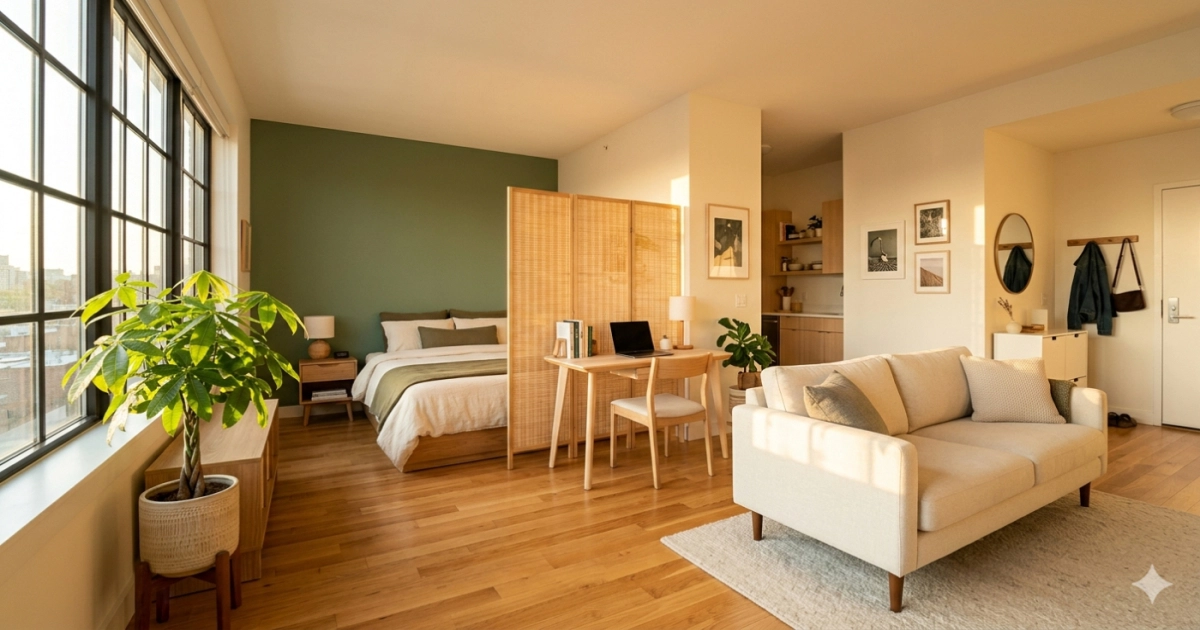
Wide-angle view of a beautifully arranged 400 sq ft studio apartment in warm afternoon light. A low platform bed sits in the far-left corner with a bamboo screen separating it from a clean wooden desk. A money tree plant glows near the window. Sage-green accent wall behind the bed. Cream-colored sofa near the entrance. Golden light. No clutter anywhere. The space feels calm, intentional, and inviting — like someone who has their life together. Editorial, aspirational photography style, 1200px wide.
MC
Maya Chen
Feng Shui Consultant · Small Space Specialist
Maya has spent seven years applying classical feng shui principles to urban apartments across three cities. She trained under two traditional practitioners and has personally redesigned her living space four times using the methods she writes about — including the 380 sq ft studio that started this whole obsession. She writes about making feng shui practical for renters and small-space dwellers who don’t own their walls.